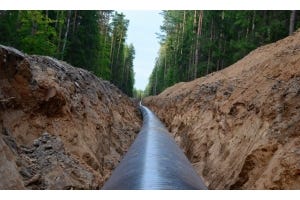


Petersen Custom Inflatable Pipe Plug Enables Diverless Arctic Pipeline Deployment


At an Arctic mine site, a 20-inch HDPE discharge line needed to be plugged and submerged to a depth of 270 feet and then that plug needed to be removed… without divers. Petersen Products rose to the challenge.
"We were tasked to develop a novel pipe design and deployment methodology for the installation of two 20-inch HDPE mine tailing discharge pipelines in an atypical marine pipeline environment," said Adrian Hannam, the engineer who led the design-build project for Great Pacific, a consulting firm based in Canada. “And using divers in this environment, at this depth, was basically impossible—for one thing, transporting a hyperbaric chamber to a remote arctic location would have been prohibitively expensive.”
The two discharge lines, each over 200 meters long, were intended to carry dense, cold tailings water from a decommissioning tailings pond to a flooded open-pit mine, and discharge 83-meters (270-feet) subsurface to create a stable state of ‘meromixis’—a condition in which a body of water has layers that do not completely mix or circulate. Environmental regulations required this so that the surface remained unadulterated freshwater, thus protecting wildlife from mine tailings.
Hannam’s design called for a full-diameter open terminus, and this in turn posed the major challenge to pipeline installation; namely, how could the HDPE pipes be kept sealed while being submerged, and be unsealed at the desired depth?
He knew it would be tricky. On a 2019 Arctic project, he had sunk a 2.2-kilometer outfall to 155 feet, without divers, and tried using a galvanic cell—coupling mild steel to magnesium—to corrode fasteners and release a blind flange underwater. But the receiving water was too fresh (too low in dissolved salts) for that approach to work quickly enough. Explosives were also ruled out—Hannam notes that "HDPE is amazingly tough" and charges merely pinched the pipe, rather than opening it.
With divers impractical, galvanic methods too slow, and explosives unworkable, an inflatable plug emerged as the only possible solution. But not just any plug would do.
The Requirements
Hannam initially considered an off-the-shelf inflatable municipal plug from Petersen Products' catalog. But after a conversation with Petersen engineer Devon Swartzentruber, it became clear that a custom-fabricated plug would be needed to meet the project's demanding specifications:
- Pipe compatibility: When deflated, must pass through a DR11 20-inch HDPE pipe (16.146-inch ID), then expand sufficiently to seal a 20-inch DR17 HDPE pipe (17.507 ID)
- Pressure: Pressurizable to 300 psi during deployment to withstand both internal pressurization and external hydrostatic head at depth
- Remote operation: Remotely fillable and ventable via a valve on a 100-meter-plus air hose from the surface—no diver access required
- Pulling eyes: Rated for over 2 tons tensile capacity each, for surface recovery
- Weight: Under 500 lbs
- Temperature: Air from +30°C (+86°F) to -20°C (-4°F); water from +10°C (+50°F) to -2°C (+28°F)
A late season freeze risk also prompted consultation. Petersen advised filling the plug with an antifreeze-doped solution to protect against ice expansion if winter arrived before deployment.
Petersen's Custom Solution
"For this type of inflatable end-inflation plug, this is the highest PSI requirement I’ve ever seen specified,” said Devon Swartzentruber, the Petersen engineer who designed the plug. "I don't know if any other company would build this high pressure on a plug like this."

The Petersen innovation that was key to achieving that high-pressure performance was an intensively designed multi-layer fabric architecture that included:
- Polyurethane bladder: The innermost layer contains the inflation fluid. Petersen used radio frequency (RF) welding to fuse the polyurethane seams, melting the material from the inside out to form a strong fused bond.
- Nylon webbing: Over the bladder, a net of heavy-duty nylon webbing constrains the expansive forces at 300 psi. The webbing is spliced using techniques similar to those used for heavy-duty tow straps.
- Nylon fabric matrix: Fabric sewn into the webbing creates a layered matrix that distributes pressure loads across the plug's surface.
- Custom metal flange: A custom-fabricated flange provides the structural interface between webbing and plug body. Rather than clamping onto fabric—which relies on friction—the flange incorporates internal rods that the webbing wraps around and splices back into, creating a mechanical attachment inherently more secure than a friction-based clamp.
Petersen sourced the raw materials separately and combined them in-house into the finished composite, engineering each layer for the target pressure and size. "It's a completely Petersen-engineered product suited to this particular plug,” Devon said.
The Deployment
Parts of Great Pacific’s installation procedure were as novel as plug design. Instead of a tugboat, for example, a sea can loaded with 20 tons of ballast, a wire rope running down the pit bench, and a front-end loader (used as an anchor) were used to maintain tension and control the discharge line descent. And Hannam likens the pipe configuration to the breech of a rifle—the plug was seated in a short 20-inch HDPE section of slightly larger interior diameter, between sections with smaller ID, and the transition created an internal lip that served as plug backstop.


The plug was pressurized to 200 psi before the lay began—that’s about six times the pressure maintained in a car tire. As water was flooded in from shore, air was vented through a riser. "The plug was pressurized at 200 psi and my deployment pressure upstream of it only went to 65 psi," Hannam explained. "So about 135 psi differential."
Once the pipe reached the bottom at 83 meters, the entire outfall was pressurized to 160 psi. Then, from the surface, the plug was depressurized. "The plug just popped out," Adrian said, and was recovered by cable—no diver intervention was required.
Results
Three plugs were fabricated; two were deployed, one was held as backup. The project was completed three days ahead of schedule. Hannam wrote:
"We appreciate your team producing this custom plug for our application as this has added a completely new way for our team to deploy marine pipelines, and without divers. We have one very happy client, and an engineering team keen to use the same approach and products again in the future."
For Great Pacific, the plug opened up new options for future projects involving large volumes of water, deep deployment, and limited diver access.
# # #
Angus Stocking is a former licensed land surveyor who has been writing about infrastructural and geospatial technology since 2002.